Saratoga 1777
The British plan for 1777 was to cut the rebellion in half. An army under General John Burgoyne would come south from Canada by Lake Champlain, another would move up the Hudson from New York City, and the two would meet near Albany, severing New England from the rest of the colonies. It was a reasonable plan on a map. It failed in the country north of Albany, and the failure decided the war.
The march south
Burgoyne set out in June with about eight thousand men and a heavy artillery train. Ticonderoga fell to him in July without a fight, which was thought a triumph in London. Then the difficulties began. The Americans felled trees across the tracks, broke the bridges and drove off the cattle. A detachment sent east to gather supplies was destroyed at Bennington in August. The force that was to have come up the Mohawk valley to meet him turned back after the siege of Fort Stanwix.
The army moving up the Hudson never came at all. Its commander, Sir William Howe, had gone to take Philadelphia instead. Burgoyne, by September, was alone in the woods with a shrinking army and a supply line he could not hold.
Freeman’s Farm and Bemis Heights
The Americans, under Horatio Gates, had entrenched on Bemis Heights where the road ran between the bluffs and the river, a position chosen and fortified by the Polish engineer Tadeusz Kosciuszko. Burgoyne had to go through them.
He attacked on 19 September at Freeman’s Farm and held the ground at the end of the day, but at a cost he could not bear; American riflemen had shot down his officers in numbers. He waited three weeks for help that was not coming, and attacked again on 7 October at Bemis Heights. This time he was thrown back decisively. Benedict Arnold, who had been relieved of command after quarrelling with Gates, rode onto the field without orders and led the assault that broke the British right, taking a wound in the leg that ended his part in the fighting.
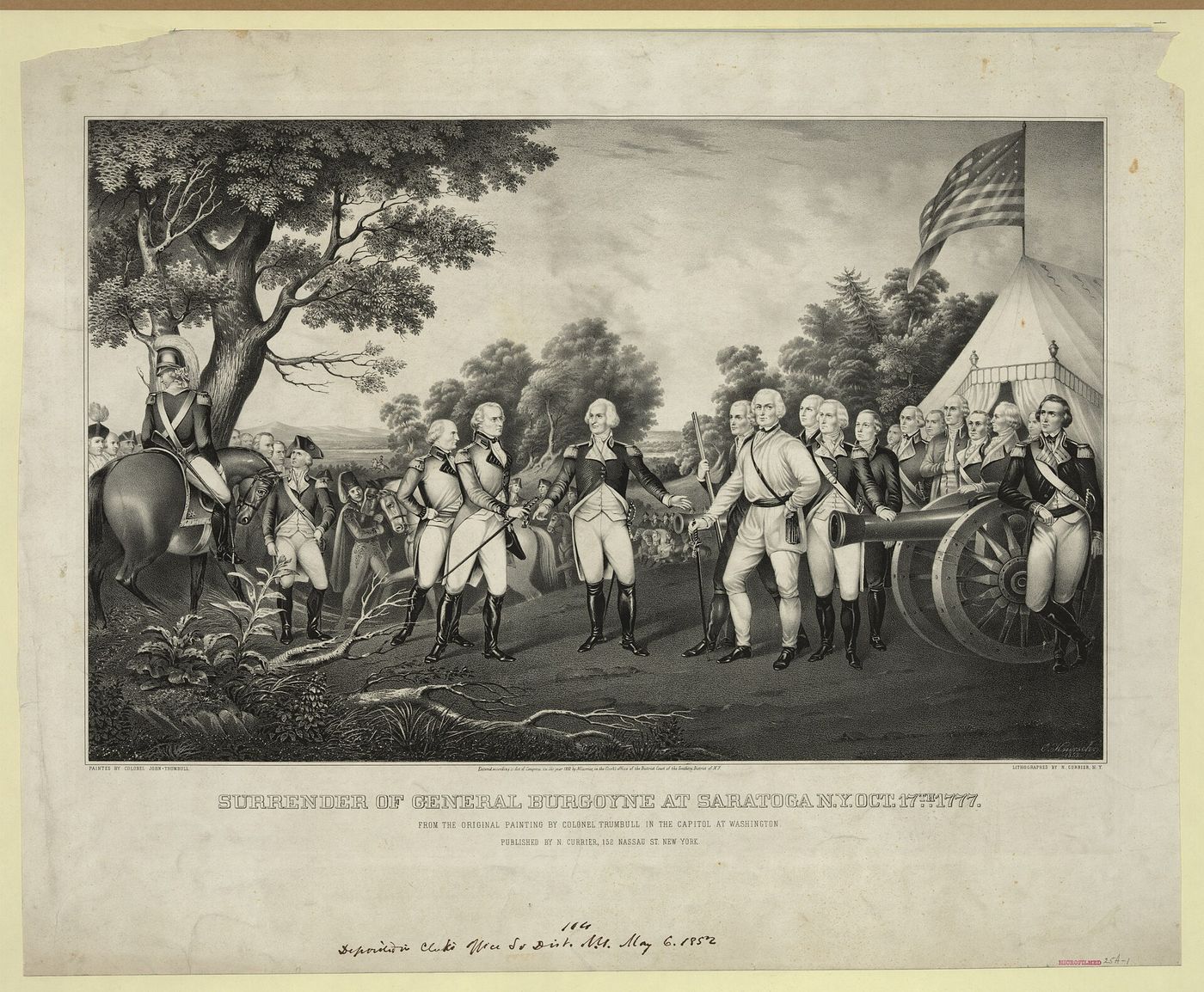
Burgoyne withdrew to Saratoga, found himself surrounded, and surrendered his army on 17 October 1777.
What followed
Nearly six thousand men laid down their arms. The military consequence was serious enough, but the diplomatic one was decisive. France had been supplying the Americans quietly and weighing whether to do more; Saratoga was the evidence that the rebellion could beat a British army in the field. The Treaty of Alliance was signed in February 1778, and with it came the French fleet, without which Yorktown would not have been possible.
The battlefield is now a national historical park. The monument at the site of Arnold’s wounding bears a boot and no name, commemorating the leg of an officer whose later treason the country has never quite known how to record.