Niagara Falls
The Niagara River runs only thirty-five miles, from Lake Erie to Lake Ontario, and it spends most of that distance being unremarkable. Halfway along, it drops about 167 feet over a limestone ledge, and that drop has shaped the economy of western New York for two centuries.
Three falls
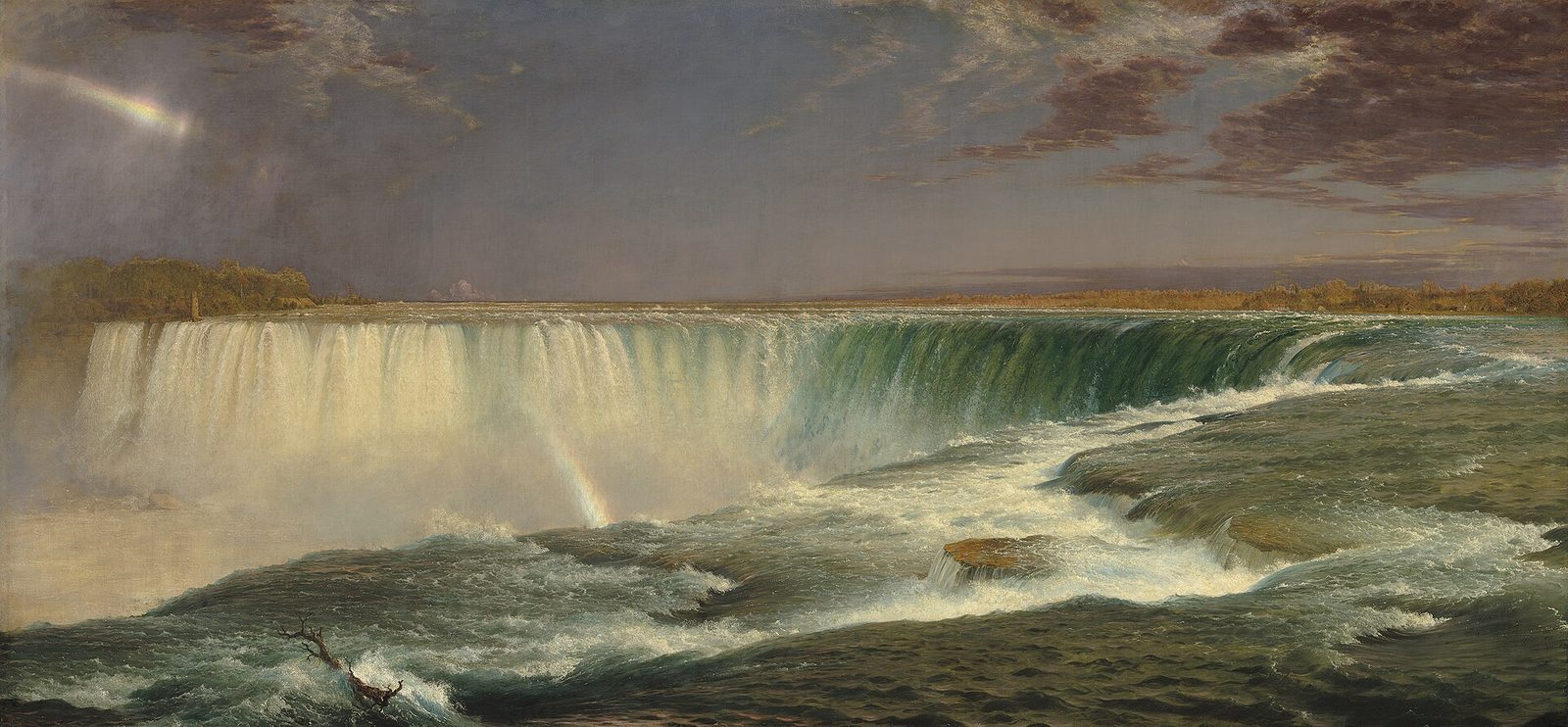
What visitors call Niagara Falls is three waterfalls. The Horseshoe Falls, the largest, lies mostly on the Canadian side; the American Falls and the narrow Bridal Veil Falls are on the New York side, separated by Luna Island. Goat Island sits between the American and Canadian cataracts and has been a viewing place since the earliest days of the tourist trade.
The ledge is not fixed. The falls have been retreating upstream since the end of the last glaciation, cutting the gorge below them as the soft shale beneath the hard dolomite is undermined and the cap collapses. The rate has slowed considerably since water was diverted for power.
The tourist trade
Niagara became a destination remarkably early. By the 1820s it was on the itinerary of European travellers, and the completion of the Erie Canal in 1825 put it within reach of anyone who could buy a passage. It also acquired, quickly, a reputation for being spoiled: mills, hotels and fences crowded the bank, and access to the best views was sold.
The campaign against this produced something new. Frederic Church, whose enormous canvas of the falls made his reputation in 1857, joined the landscape architect Frederick Law Olmsted and others in a movement to take the shoreline back into public hands. They succeeded in 1885, when the state established the Niagara Reservation, the first state park in the United States. Olmsted and Calvert Vaux prepared the plan for it, with the deliberate aim of hiding the works of man and restoring the approach to something like its earlier condition.
Power
The same drop that drew tourists drew industry. Small mills used the current directly from the early nineteenth century, but the decisive moment came in the 1890s, when the question of how to move power away from the river was settled in favour of alternating current. The Adams Power Plant, opened in 1895 with generators built to designs licensed from Nikola Tesla by Westinghouse, sent electricity to Buffalo twenty-six miles away. It was the demonstration that ended the argument between direct and alternating current, and it made Niagara a byword for industrial electricity.
Cheap power drew the industries that needed it most: aluminium, abrasives, chemicals, electrochemical works of every kind. The city of Niagara Falls grew around them, and declined with them in the second half of the twentieth century. Treaty arrangements now limit how much water may be diverted, more in the tourist season and less at night and in winter, so that the spectacle and the generating capacity share the same river on a published schedule.